 Pretzly
German Separable Verbs, Explained
Mark Twain joked that German verbs arrive in installments. He meant these: Ich stehe um sieben auf — the verb is aufstehen, and the auf- waited at the end of the sentence.
What separable verbs are
German builds new verbs by bolting prefixes onto base verbs: stehen (stand) → aufstehen (get up), rufen (call/shout) → anrufen (phone someone). With separable prefixes, the prefix detaches in a normal main clause and moves to the very end:
Ich stehe jeden Tag um sieben auf.
Er ruft seine Mutter an.
This is why beginners get ambushed: you hear a familiar verb, build your interpretation, and the final word changes everything. The fix is knowing the prefixed verb as its own vocabulary item — anrufen is not "rufen + decoration", it's a different verb with a different meaning.
Which prefixes separate?
| Type | Prefixes | Example |
|---|---|---|
| Separable (stressed) | ab-, an-, auf-, aus-, ein-, mit-, nach-, vor-, zu-, zurück-, weg- | aufstehen → ich stehe auf |
| Inseparable (unstressed) | be-, emp-, ent-, er-, ge-, ver-, zer- | verstehen → ich verstehe |
| Both (meaning decides) | um-, über-, unter-, durch-, wieder- | umfahren: ich fahre ihn um (run over) vs ich umfahre ihn (drive around) — stress matters! |
The audio shortcut: if the prefix is stressed, it separates (AUFstehen → separable; verSTEHen → inseparable). One more reason to learn every verb with its sound, not just its spelling.
Where the prefix goes, tense by tense
- Present / Präteritum main clause: prefix to the end — Ich stehe um 7 auf.
- Perfekt: ge- squeezes between prefix and stem — aufgestanden: Ich bin um 7 aufgestanden. (Inseparable verbs take no ge- at all: verstanden. See the Perfekt guide.)
- With zu: zu squeezes in the same slot — Es ist schwer, früh aufzustehen.
- Subordinate clause: the verb reunites at the end — …, weil ich um 7 aufstehe.
- With a modal: whole infinitive at the end — Ich muss um 7 aufstehen.
The separable verbs to learn first
These are everywhere in daily German: aufstehen (get up), anrufen (call), einkaufen (shop), anfangen (begin), aufhören (stop), mitkommen (come along), zurückkommen (come back), ausgehen (go out), fernsehen (watch TV), abholen (pick up), einladen (invite), vorbereiten (prepare).
Learn the verb, its split and its sound together
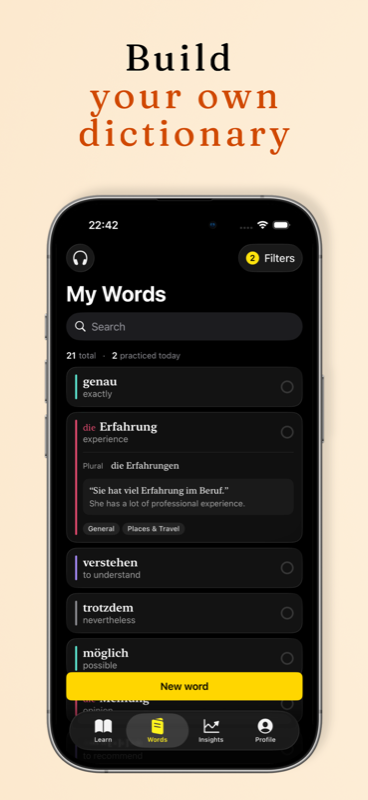
In Pretzly every verb card carries example sentences that show the separation in action — Er ruft seine Mutter an — plus audio so the stress pattern (AUFstehen vs verSTEHen) trains your ear from day one. Add any verb; AI Autofill builds the card with forms and examples.


The habit that makes them stick
When you meet a new separable verb, never save just the infinitive. Save it with one sentence where it splits: "anfangen — Der Film fängt um acht an." That single example encodes the separation, the stem change (fängt!) and the word order — three grammar lessons hidden inside one vocabulary card.